Stop fixing broken OCR text.
Continuous paragraphs. Structured Markdown.
Generic OCR breaks every line with a hard return and mashes columns together. OCRtoText preserves natural reading order, formats clean Markdown ready for LLMs, and provides on-demand verification against the original source.
Drop photo, screenshot or PDF here, or browse files
Press Ctrl+V / Cmd+V to paste clipboard screenshots directly
This file needs GPU OCR
We detected no text layer: this is a scan, a photo or a screenshot. There are no characters to copy out, so the page has to go through vision OCR on a GPU — the one part of this tool that costs real compute.
Every network gets one free GPU OCR to try it, and this one has been used. After that, OCR runs on a one-time page pack — from $6.9 for 50 pages, never expires, no account or email required (the code is your account). Digital PDFs with a text layer stay free: 10 a day.
Your reconstructed text appears here. Files are processed in memory and never stored.
See what publication-grade precision looks like
Generic OCR turns fractions into slash-mangled text, destroys subscripts, and cuts equations in half. Below is a real, unedited extraction from the seminal Google Brain Transformer paper.
Attention(Q, K, V ) = softmax( QK T \/dk )V (1)
The two most commonly used attention functions are additive
attention [2], and dot-product (multi-
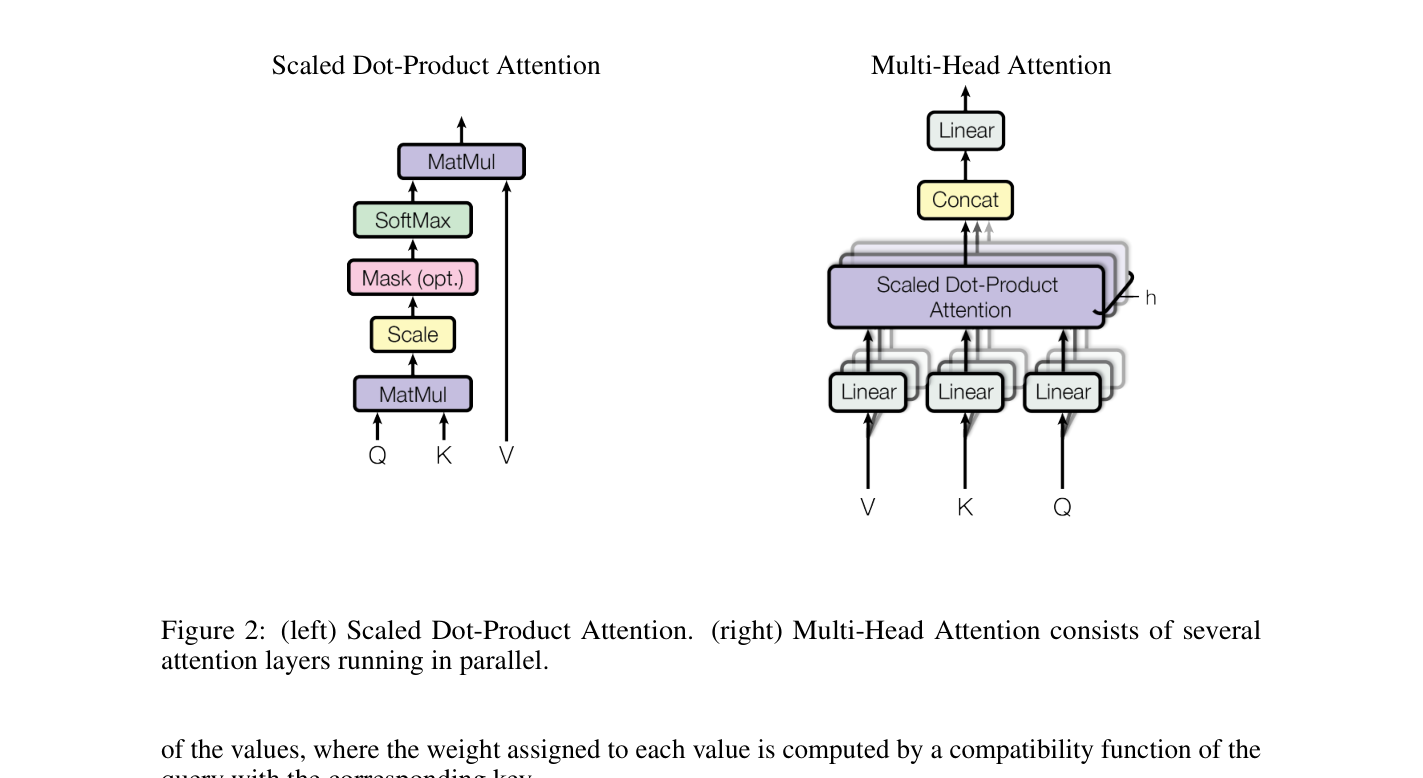
Fractions destroyed · Subscripts converted to normal text · Jagged hard breaks every 6 wordsWe call our particular attention "Scaled Dot-Product Attention" (Figure 2). The input consists of queries and keys of dimension d_k, and values of dimension d_v. We compute the dot products of the query with all keys, divide each by √d_k, and apply a softmax function to obtain the weights on the values.
The two most commonly used attention functions are additive attention, and dot-product (multiplicative) attention. Dot-product attention is identical to our algorithm, except for the scaling factor of 1/√d_k. Additive attention computes the compatibility function using a feed-forward network with a single hidden layer. While the two are similar in theoretical complexity, dot-product attention is much faster and more space-efficient in practice, since it can be implemented using highly optimized matrix multiplication code.
• Auto-unwrapped paragraphs: 0 manual backspaces required
• Strict column-by-column reading order
Need this precision for your papers, theses & lab archives?
Digital PDFs with native text layers are free (10/day). For scanned papers, camera photos, and pre-print archives that demand deep GPU vision models, buy a one-time pack that never expires.
- • 50 scanned pages
- • Full LaTeX & math AST
- • Never expires
- • 200 scanned pages
- • Priority GPU queue
- • University invoice support
The difference between raw characters and usable text
Traditional OCR gives you a fragmented puzzle of words with hard breaks every five words. OCRtoText reassembles the syntax so you never have to delete 200 line breaks by hand.
Auto-Unwrapped Paragraphs
Sentence lines that don't end with terminal punctuation are automatically joined. Paste straight into Word, Google Docs, or Notion without pressing backspace a hundred times.
Column-Aware Reading Order
Multi-column academic papers and magazines are recognized column by column. The left column finishes completely before the right column begins—never horizontally spliced.
Markdown Ready for LLMs
Preserves headings (`#`), bullet lists (`-`), code fences, and tables. Click "Copy for AI" to get an instantly prompt-wrapped snippet ready to paste into ChatGPT or Claude.